
Introducing ros2in1_support
With ROS 1 now being End of Life, many developers face an urgent question: how to transition to ROS 2 without large disruptions?
Read moreThe demo convinced everyone. Now the robot has to work every day, on every unit, after every update, without a PhD next to it. That is a different engineering discipline - and it is ours.
![AI-generated (Grok, Peter's pick from the 6-up contact sheet 2026-09-04): engineer cabled into the first of a row of identical AMRs in a staging hall, upscaled to 2048px ([[label as illustration? site-wide decision]])](/assets/images/_1600xAUTO_fit_center-center_82_none/22660/expertise-380347aba741-hero-amr-provisioning.webp)
A working prototype proves the robot can do the job. Turning it into a product means making that success repeatable across units, customer sites and software releases. Three foundations make that possible:
That is an opportunity to grow the fleet while reducing the engineering effort needed to deploy, update and support each additional robot.
Since 2010 we have taken robot software into production for mass-market cleaning robots, retail fleets, drones, and mission-critical space systems. We bring that playbook to your product:

The goal is software your team can deploy, update and support across a growing fleet - with the tests, documentation and tooling to carry it forward.

Situation. A young company had an autonomous cleaning robot working as a proof of concept and a first fleet of customer units to deliver within months.
What we did. We reviewed the architecture and the production-hardening plan, brought the reliability of their software stack to industry-grade performance figures, and designed and implemented how their software is built, tested and deployed onto robots in the field using modern standards: a minimal Linux image with A/B partitioning on the production system-on-module, resource validation of the full stack on that module, watchdogs and health monitoring, and a validation test set.
Outcome. With a small team at the customer, the delays were worked away and robots reached real customers.
Also: Porting the heaviest nodes from Python to C++ cut their CPU load by ~80%.

Situation. A large team of robot-software developers needed a common foundation to build interoperable modules on.
What we did. We created the ROS 2 base layer and target platform, benchmarked and selected the right ROS 2 middleware, and designed the deployment architecture and fleet-provisioning strategy so that known weaknesses of ROS 2 do not disturb the functional design.
Outcome. Standardised tooling across a large organisation, and new hires productive quickly thanks to the popular, easy-to-use ROS 2 APIs.
Also: The middleware work included an in-depth study of inter-container communication.
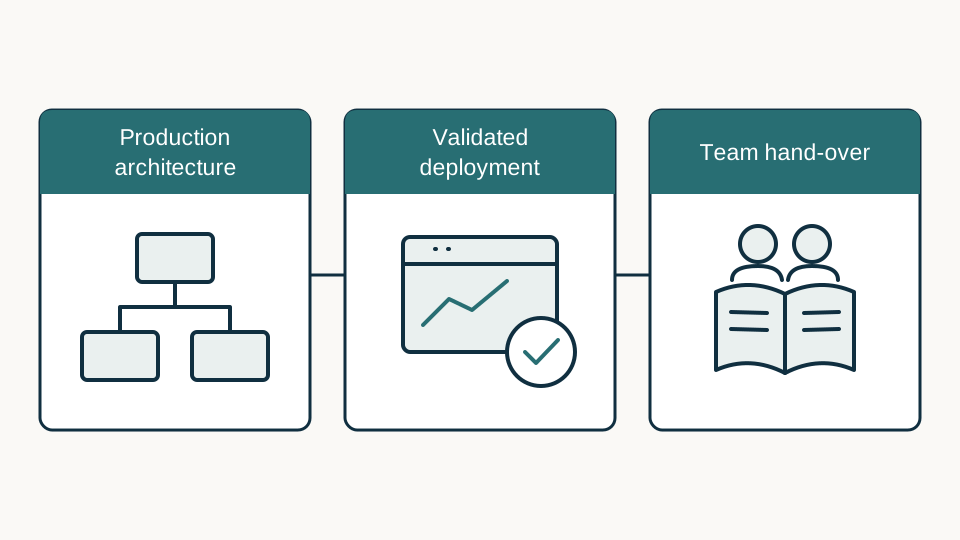
Typical engagement: a 2–4 week architecture review with a concrete plan, followed by software development embedded in your team.
With ROS 1 now being End of Life, many developers face an urgent question: how to transition to ROS 2 without large disruptions?
Read more
Creating a mobile robot for indoor transportation can be a challenging task, especially when it comes to overcoming hardware and software issues. This guide will provide a high level overview of the various hardware and software challenges involved in creating a mobile robot, as well as the best solutions for overcoming them.
Read more"Ready to leave the demo phase?" Book an architecture review